
AI Drama Ads: How to Make Micro-Drama Ads That Sell (2026 Guide)
 11 min read
Drama ads are short, vertical ads written like a soap opera: a conflict in the first second, rising tension, a twist, and a product that changes the ending. They borrow the format of the micro-dramas that people now binge on apps like ReelShort and on TikTok, and AI makes them cheap enough to produce in volume.
This guide explains what drama ads are, why the format works, the five-beat structure behind a good one, the storylines that suit DTC products, and how to make one with AI step by step, with a full example we produced for this article.
In short: a drama ad is a 20 to 40 second scripted mini-story in vertical video. Start in the middle of a conflict, raise the stakes, let the product cause the twist, show the payoff, and end on a cliffhanger or a call to action. With AI you can cast consistent characters, generate the scenes and the dialogue, and test several hooks for the price of one shoot. Keep it clearly fictional, never sensational, and label the AI where platforms require it.
What is a drama ad?
A drama ad is a scripted, story-driven ad shot like a scene from a series: two or three characters, a recognisable situation, an emotional hook, and a resolution that involves the product. It sits between entertainment and direct response.
The industry doesn't have one name for it yet. Marketers talk about micro-drama ads, branded micro-dramas, skit ads or two-person skits, and TikTok calls the series version Mini Dramas. Performance creative strategist Savannah Sanchez listed two-person skits among the winning formats on TikTok and Meta because they "don't look like an ad" and work even for generic products.
Why drama ads are taking off
The format comes from vertical micro-dramas, one of the fastest-growing categories in mobile entertainment:
- $11 billion in 2025: Omdia estimates global micro-drama revenue at about $11 billion in 2025, rising to about $14 billion by the end of 2026, with the US as the largest market outside China.
- More time than Netflix: using Sensor Tower data, Omdia found US ReelShort users spend about 36 minutes a day in the app, versus about 25 for Netflix.
- TikTok is pushing it: TikTok launched a standalone micro-drama app, PineDrama, in January 2026, and an ad product to promote brand Mini Dramas in June 2026.
- Brands are in: Crocs, Dr Pepper, Maybelline, P&G and the rental brand Nuuly have all released branded micro-drama series since 2025.
For performance advertisers, the takeaway is simpler: audiences are now trained to watch a vertical story through to the twist. That attention is what a drama ad captures.
Why the format works for ads
- Stories outperform promos: a TikTok and Dentsu marketing-mix study of 15 brands found storytelling UGC delivered 70% higher ROI than purely promotional UGC.
- Faces and speed: a Kantar, Meta and CreativeX study of nearly 57,000 Meta ads found that showing a human with eye contact raised effectiveness by 81%, and fast storytelling (four scenes in six seconds) by 73%.
- Brand early, story still intact: Meta and Toluna found that showing the brand and core message in the first five seconds made strong purchase intent 1.7 times more likely. The same Kantar study found only 36% of campaigns integrate the brand into the story well.
A drama ad solves that tension: the product is not an end card, it's the plot device.
The 5-beat structure of a drama ad
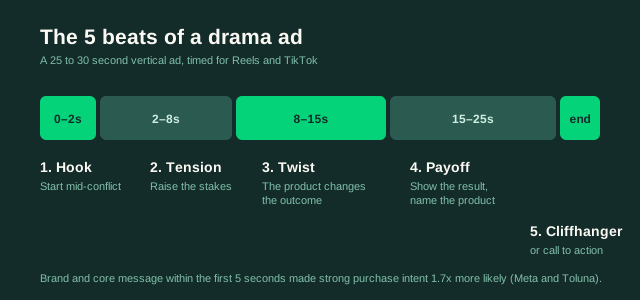
| Beat | Timing | What happens | Example |
|---|---|---|---|
| 1. Hook | 0–2 s | Open in the middle of a conflict, no setup | "She has hated every coffee I've made for six years." |
| 2. Tension | 2–8 s | Raise the stakes, show what's at risk | The mother-in-law takes the first sip, eyes narrowed. |
| 3. Twist | 8–15 s | The product changes the outcome | She smiles: "What is this?" |
| 4. Payoff | 15–25 s | Show the result and name the product | The bag of coffee, the reaction, the offer. |
| 5. Cliffhanger | Last 2 s | A reason to watch the next one, or a call to action | "Wait until she finds out what it costs." |
Keep the product inside the story from the twist onward, and show your brand early (on a mug, a package, a screen) rather than only on the last frame.
7 drama storylines that sell
- The impossible-to-please judge: a mother-in-law, a picky partner or a strict boss who finally approves, thanks to the product.
- The almost-return: someone is about to send the product back, then sees the result.
- The secret: a friend keeps getting compliments and finally reveals what she uses.
- Caught red-handed: a partner or roommate secretly using your product.
- The rival: a colleague or neighbour whose results look too good, until the reveal.
- The glow-up: the change after weeks of using the product, told as a before-and-after story rather than a side-by-side claim.
- The mistake: the character tries the cheap alternative first, it goes wrong, the product saves the day.
Keep the conflict light and relatable. Family friction, small embarrassments and everyday rivalries work; violence, humiliation and fear-based shock do not, and they get ads rejected.
How to make a drama ad with AI, step by step
- Write the beat sheet: one conflict, one twist, one product moment. Write three different hooks for the same story.
- Cast your characters: generate each character once, with a clear look (hair, outfit, age), then reuse that image as a reference for every scene so faces never drift.
- Storyboard the beats: generate one still per beat in 9:16, with the same set and lighting. This is where you check continuity before spending on video.
- Animate with dialogue: turn each still into a shot with a video model that does native audio and lip-sync, such as Veo 3.1 or Kling 3.0. Give each line in quotes and describe the delivery.
- Edit like a series: fast cuts, captions for sound-off viewers, a dramatic music sting on the twist, and the product clearly visible.
- Make variations: swap the hook line, the first shot or the cliffhanger and test them against each other. If one story wins, turn it into episodes.
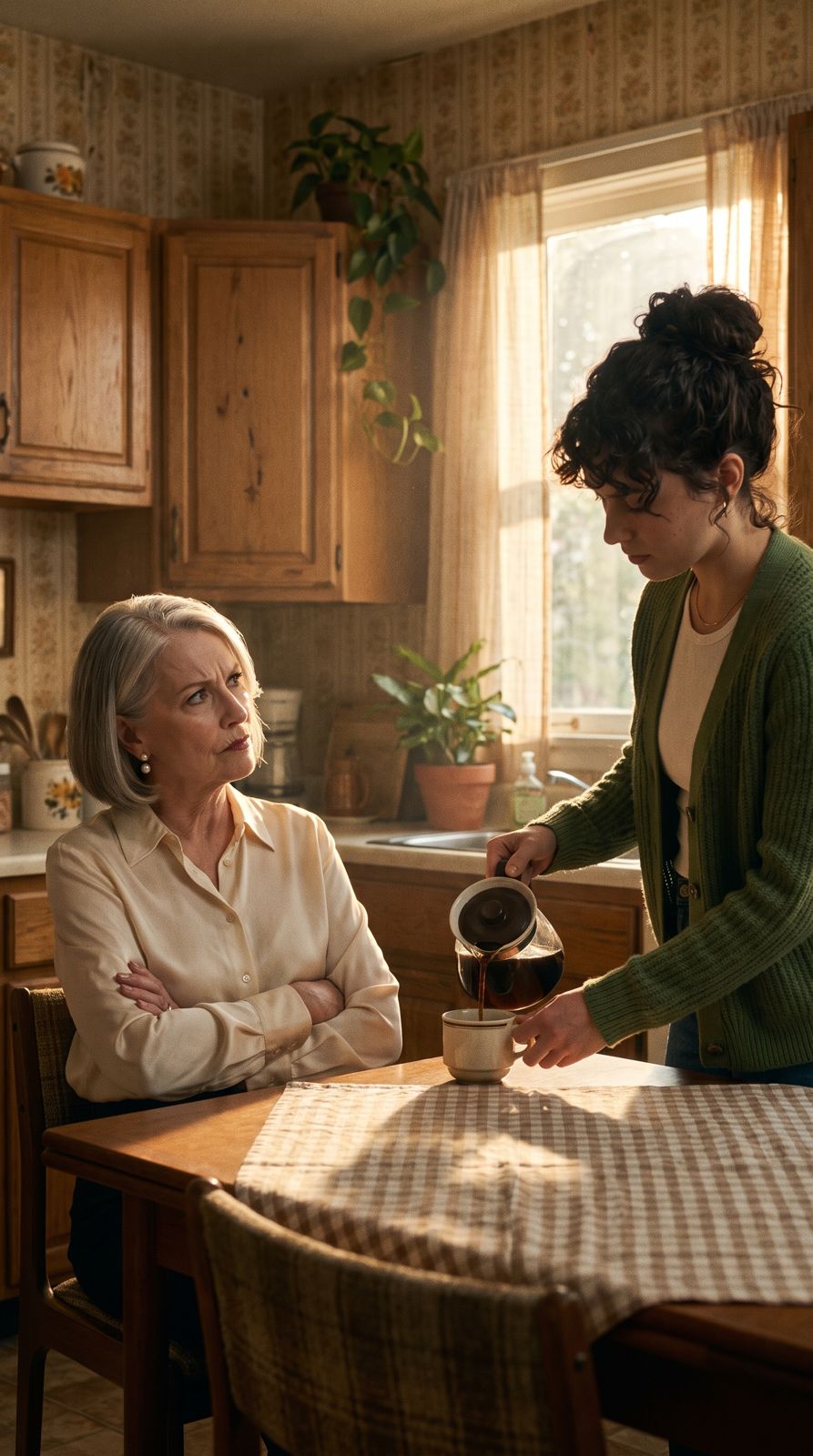
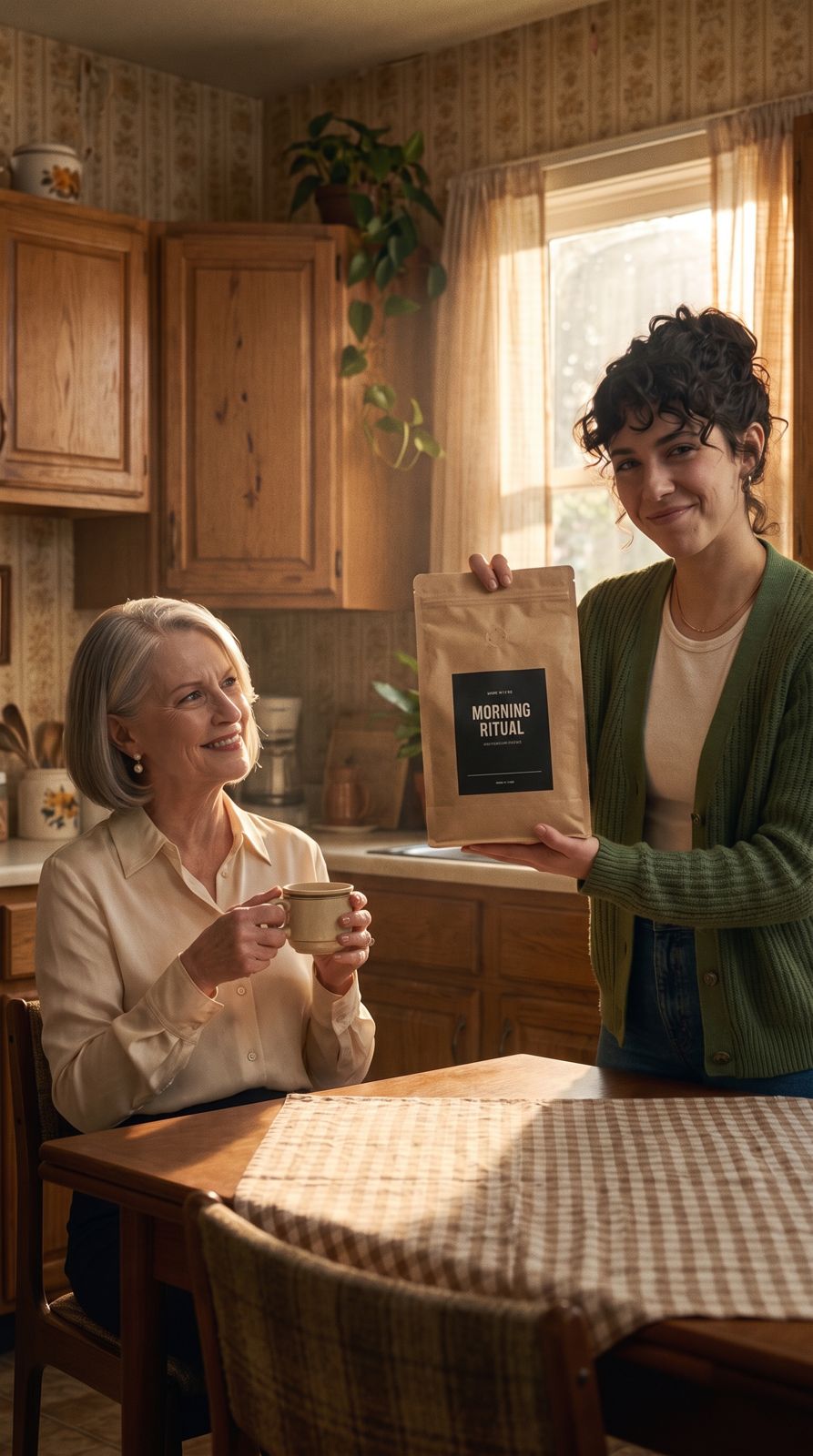
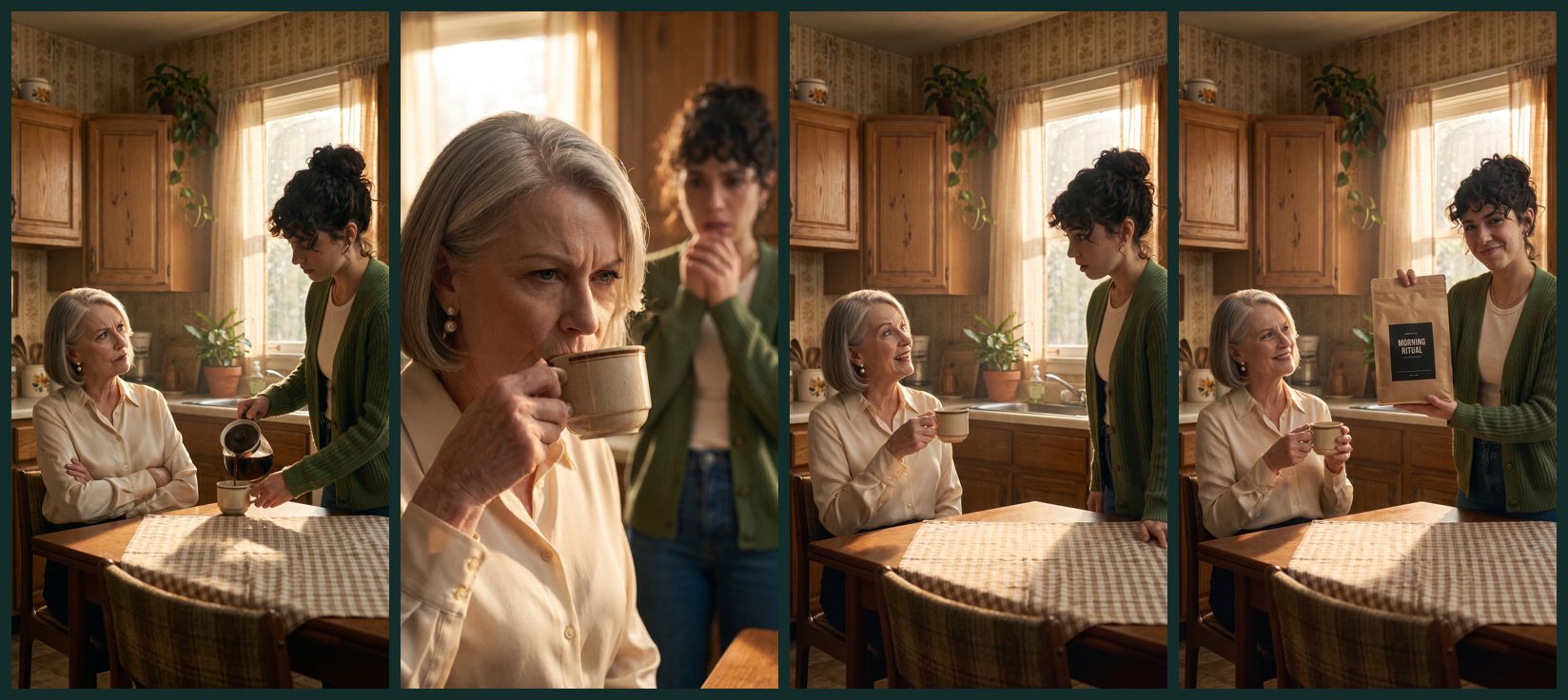
Everything in this example (characters, kitchen, coffee bag, dialogue) was generated with AI: four stills with an image model using the first frame as a character reference, and the twist animated with Veo 3.1. Our guide on how to make AI videos for ads covers the general workflow.
Tools and costs
| Tool | What it's good for | Price |
|---|---|---|
| Veo 3.1 (Google) | Realistic scenes with native dialogue and character references | About $0.40 per second via the Gemini API, cheaper Fast and Lite tiers |
| Kling 3.0 | Multi-character dialogue, multi-shot scenes up to 15 s | Credit-based, roughly $0.08–0.11 per second through resellers |
| Seedance 2.5 | Long multi-shot generations with many references | Varies by platform |
| Runway | Gen-4.5 plus hosted Kling and Seedance | From $15 a month |
| HeyGen | Talking-head avatars for simple dialogue | From $29 a month |
Prices from official pages or resellers in October 2026. Note that OpenAI shut down Sora's app in April 2026 and its API in September 2026, so it is no longer an option. Our comparison of AI video generators goes deeper on the models.
Rules to stay ad-safe
- No shock content: Meta bans shocking, sensational and graphic content in ads, and TikTok rejects shocking imagery and clickbait. Keep the drama emotional, not disturbing.
- No misleading claims: the twist can't promise unrealistic results. TikTok also restricts before/after comparisons, so tell the change as a story rather than a side-by-side.
- Fiction stays fiction: the FTC's 2024 rule bans testimonials from people who don't exist, including AI-generated ones. A scripted scene is fine; an AI character presented as a real customer review is not.
- Label the AI: TikTok requires an AI label on realistic AI content, Meta shows an "AI info" label, and the EU AI Act requires disclosure of realistic AI content since August 2026.
Common mistakes
- A slow start: if the conflict isn't clear in two seconds, the viewer scrolls.
- The product arrives too late: a story with a logo at the end is a short film, not an ad.
- Drifting faces: characters that change between shots break the illusion instantly.
- Overacting: soap-opera energy is fine; melodrama that feels fake isn't.
- One version only: drama ads are a testing format. Plan several hooks and endings.
One ad or a series?
Start with single ads: one story, one twist, several hooks, tested in your normal campaigns. When a story clearly wins, turn it into a series of short episodes that end on cliffhangers, the way Crocs did with its "Charmed to Meet You" series on ReelShort, which the brand reports passed 4.5 million views in its first week. AI makes this affordable because the characters and sets are already built.
Want drama ads made for your brand?
EditClub writes, generates and edits AI drama ads for DTC brands: consistent characters, dialogue, several hooks to test, delivered ready for Meta and TikTok. First delivery in 48 hours, from $1,600 a month.
See the AI video ad agencyWhat are drama ads?
Why do drama ads work?
How long should a drama ad be?
Can you make drama ads with AI?
Are AI drama ads allowed on Meta and TikTok?
Related reading: the complete guide to AI UGC, UGC ad examples and how to make TikTok video ads with AI.