
Meta Andromeda 2.0: What Advertisers Need to Know (2026)
 8 min read
On 28 October 2026, Meta's engineering team published the next generation of Andromeda, the system that decides which ads are even considered for each person on Facebook and Instagram. Meta doesn't call it "Andromeda 2.0", but that's what it is: a rebuilt model and a rebuilt pipeline that now scores every eligible ad, about 100 times faster than the 2024 version. Here's what changed, what it means for your Meta ads, and why the brands that win from now on are the ones with the most creative angles, not the cleverest targeting.
In short: Andromeda is the retrieval stage of Meta's ad system, the step that picks a few thousand candidate ads out of tens of millions before ranking and the auction. The 2026 version scores every eligible ad, over one billion ads per second, with a mixture-of-experts model that routes each ad, based on its content, to the user profiles it fits best. Meta says Andromeda has delivered a 2.4% increase in conversions on Facebook since 2025. For advertisers, the lesson is simple: the creative is now the targeting. Each genuinely different angle can reach a different group of people, so the more distinct concepts you feed the system, the more people it can match you with.
Feeding Andromeda takes a lot of angles
EditClub writes and produces new AI video ad concepts every 24 hours, each cut into 9 variants (3 hooks × 3 calls to action), ready for Meta in 9:16, 4:5 and 1:1. First ad in 48 hours.
Book a strategy callWhat is Meta Andromeda?
When someone opens Instagram or Facebook, Meta has milliseconds to pick one ad out of tens of millions. It does it in stages:
- Retrieval (Andromeda): from every eligible ad, keep the few thousand most likely to matter to this person.
- Ranking: heavier models predict clicks and conversions for those candidates.
- Auction: bids and predicted value decide the ad that's shown.
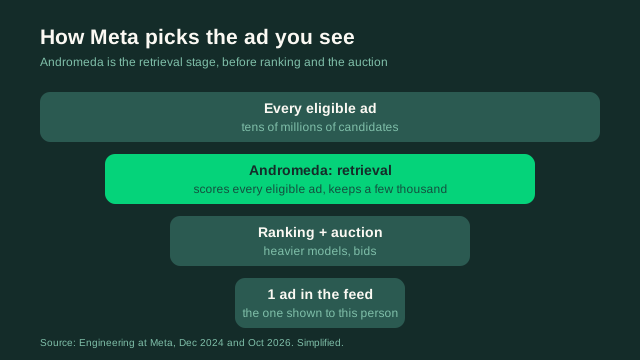
Andromeda launched in December 2024. In Meta's launch post, the first version improved retrieval recall by 6% and ad quality by 8% on selected segments. Its stated reason for existing: Advantage+ and generative AI tools were multiplying the number of ads, with more than 15 million ads created with Meta's GenAI tools in a single month. The old retrieval system couldn't keep up.
What's new in the 2026 version ("Andromeda 2.0")
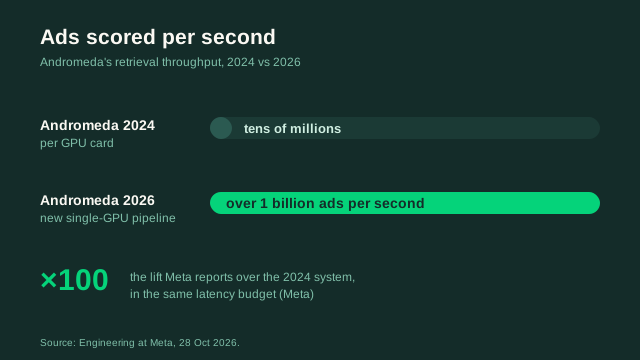
The October 2026 update rebuilds both the model and the hardware pipeline. The headline numbers, all from Meta:
| Andromeda 2024 | Andromeda 2026 | |
|---|---|---|
| Ads scored per second | Tens of millions per GPU | Over one billion, every eligible ad scored |
| How a person is modelled | One user model | A team of specialised user models ("experts") |
| How an ad is matched | Fixed scoring network | A router that sends each ad to the most relevant experts, based on its content |
| Compute per prediction | Baseline | About 300 times fewer operations |
| Reported impact | +6% recall, +8% ad quality | +2.4% conversions on Facebook since 2025 |
Three changes matter for advertisers:
- Every eligible ad gets scored. Meta says the new pipeline "scores every eligible ad with near ranking-level model performance at retrieval scale". Less luck, less dependence on account history: an ad that fits a person has a real chance of being picked.
- People are modelled from many angles. Instead of one user profile, Andromeda now uses several specialised models built from ad engagement history, cohorts, language-model features and activity across Meta's apps.
- Your ad's content decides who it reaches. The ad side combines the ad's content with the real-time context, and a router activates only the user experts most relevant to that ad. Put simply: what your creative shows and says is what Andromeda uses to match it with people.
What Andromeda 2.0 means for your Meta ads
Meta sums it up as "better performance automatically from the retrieval system matching ads across a larger candidate pool". In practice, three things follow:
- The creative is the targeting. With broad audiences and Advantage+, Meta no longer needs your interest stacks to find buyers. It reads your ads. An ad about back pain for runners and an ad about posture for desk workers will be routed to different people, even in the same ad set.
- One great ad isn't enough. If all your ads say the same thing, they compete for the same people. Each genuinely different angle opens a new pocket of buyers.
- Volume matters, but only real variety counts. Meta's own guidance asks advertisers to develop a variety of ad creative and let AI deliver the right message. Its 2024 post adds that "increased ad diversity can improve people's experience with ads". Ten copies of the same video with a different background color are not variety.
Creative diversity: a new angle vs a variation
This is where most accounts go wrong. A variation tests execution; an angle changes who the ad speaks to and why they'd buy. Andromeda rewards both, but only angles open new audiences.
| A new angle (concept) | A variation | |
|---|---|---|
| What changes | The person, the problem, the promise or the format | The hook, the call to action, the length, the caption |
| Example | "Back pain after running" vs "Posture at your desk" | Same video, 3 different first seconds |
| What it does | Reaches a different group of people | Finds the best version for the same people |
| How many | Several new ones every week | 3 to 9 per concept |
The winning setup combines both: a steady flow of new concepts, each delivered in a few variants so Meta can find the best hook and call to action for every audience pocket.
New concepts every day, 9 variants each
EditClub's creative strategists find the angles, our AI production team turns each one into 3 hooks × 3 calls to action, and you launch on Meta within 48 hours. No shoot, no creators to manage.
Book a strategy callHow to build an Andromeda-ready creative system
- Map your angles. List your buyer types, their problems, the objections they have and the moments they'd buy. Each crossing of a person and a problem is a potential concept.
- Vary the format, not just the words. UGC-style testimonial, product demo, founder story, before/after, mini-drama ad, comparison. Different formats catch different people.
- Ship new concepts every week. Andromeda keeps scoring every eligible ad, so a fresh concept gets a fair shot fast. Without new concepts, performance decays as audiences tire of the same message.
- Give each concept a few variants. Three hooks and three calls to action per concept is enough for Meta to find the best combination.
- Keep targeting broad and let the system work. Advantage+ and broad audiences let Andromeda route each creative to the people it fits.
- Read results by concept, not by ad. Keep the angles that bring buyers, retire the ones that don't, and brief new concepts from what you learn.
The bottleneck is no longer the algorithm, it's production: few teams can write, shoot and edit several new concepts a week. That's exactly what AI video ad production solves: no casting, no shoot, a new angle tested in days instead of weeks.
How EditClub helps you win with Andromeda
EditClub is an AI video ad agency built for exactly this new reality:
- New concepts every 24 hours: our creative strategists find the angles, write the scripts and plan your testing.
- 9 variants per concept: 3 hooks × 3 calls to action, edited and ready for Meta.
- No shoot: AI actors, product scenes and B-roll, so a new angle never waits for a filming day. See what AI UGC looks like.
- First ad in 48 hours, in 9:16, 4:5 and 1:1 for Feed, Stories and Reels.
More than 45 brands trust us with their creative, including Airbnb and Dyson, and over $2M of ad spend runs on EditClub videos every month. If your account is stuck on a handful of ads, Andromeda is telling you something: it needs more angles. See how we work as a Meta ads creative agency.
Common mistakes since Andromeda
- Calling small tweaks "diversification". A new background or a new caption on the same video doesn't open a new audience.
- Over-segmenting campaigns. Splitting budget across many narrow ad sets starves each one. Fewer, broader ad sets with more creative work better with an automated system.
- Judging an angle too fast. Give each new concept enough budget and a few days before cutting it.
- Running out of creative. The most common reason performance drops is simply that the same ads have been seen too many times.
Your next 30 days of Meta creative, planned for Andromeda
On a 15-minute call, we'll look at your current ads and map the angles you're missing. Then we produce them: new concepts every 24 hours, 9 variants each.
Book a strategy call