
How to Outsource Your Ad Creatives in 2027: A Guide for DTC Brands
 9 min read
Meta and TikTok now reward brands that feed them a steady flow of new ad concepts. Most DTC teams can't produce that many in-house, so they outsource their ad creatives: the hooks, scripts, videos and edits, while they keep the strategy decisions and the media buying.
This guide explains what you can outsource, when it makes sense, your options, what a good partner delivers, how the process works, what to put in the brief and the contract, and how to tell whether it's working.
In short: outsource creative production first (hooks, scripts, AI or filmed footage, editing, formats), outsource creative strategy with it if your team lacks the time, and keep campaign management in-house or with your media buyer. Choose a partner that ships new concepts every week, several variants per concept, finished and in every format, with full ownership of the files. Judge it on hook rate, thumb-stop and cost per purchase, not on how pretty the reel looks.
What “outsourcing ad creatives” actually covers
An ad is three different jobs. Mixing them up is the most common reason outsourcing disappoints.
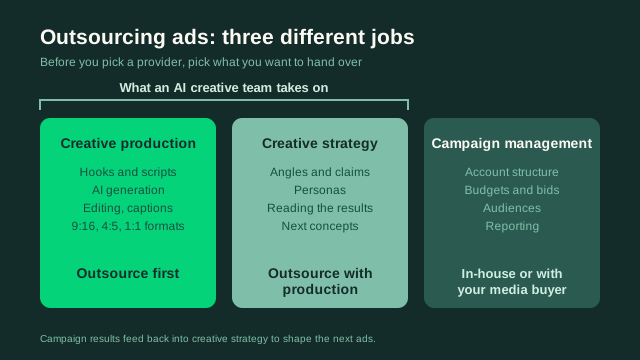
- Creative production: hooks, scripts, AI generation or filming, editing, captions and the 9:16, 4:5 and 1:1 exports. This is the most time-consuming part and the easiest to hand over.
- Creative strategy: which angles, claims and personas to test next, based on what the data says. It works best when it sits with the team that produces the ads.
- Campaign management: account structure, budgets, bids, audiences and reporting. That is media buying, a different job, and it usually stays in-house or with a specialist.
When it's time to outsource
- Your best ads are fatiguing and you can't replace them fast enough: frequency climbs, CPMs rise and ROAS slips.
- You test fewer than a few new concepts a week. Since Meta's Andromeda update, the delivery system rewards real creative diversity, not small tweaks of the same ad (see Meta Andromeda explained).
- Your marketers spend their days editing instead of planning, analysing and talking to customers.
- Shoots are your bottleneck: casting creators, shipping product and waiting weeks for footage.
- Your in-house output is inconsistent because it depends on one editor or one designer.
Your options
| Option | What you get | Best for | Watch out for |
|---|---|---|---|
| Freelancers | One editor or creator at a time | Occasional, low volume | You become the project manager |
| UGC creator platforms | Raw creator videos | Brands that want human testimonials | Editing, hooks and variants are still on you |
| Traditional creative agency | Concepts and polished shoots | Brand campaigns, big launches | Slow cycles and high cost per asset |
| AI ad agency | Concepts, AI production and editing, at volume | Brands that need weekly testing volume | Check strategy quality, not just the tech |
We compare these in detail in AI ad agency vs freelancer vs in-house team, and break down prices in how much an AI ad agency costs.
What a good partner should deliver
- New concepts every week, each built on a distinct angle, not the same ad with a new colour.
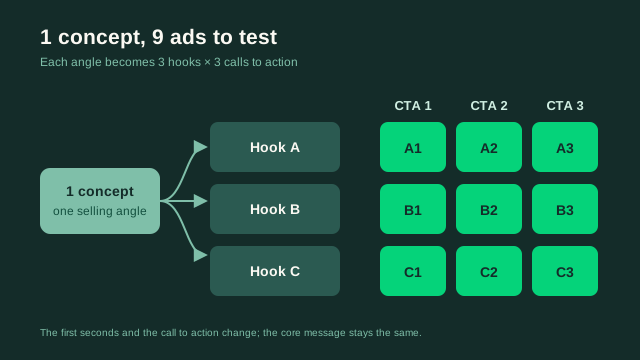
- Several variants per concept, typically different hooks and calls to action, so you test the first seconds without rewriting the whole ad.
- Finished ads, edited, captioned and exported in every placement format, ready to upload.
- Strategy notes: why each concept exists and what it is supposed to prove.
Here is the kind of output to expect from an AI production team: creator-style formats made without a shoot.
More formats and what each one is good for in UGC ad examples.
How the process works
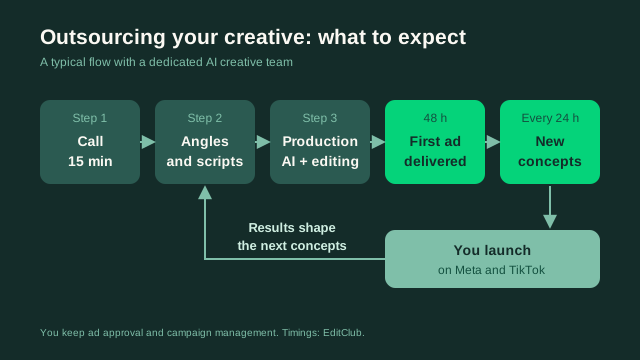
- Kick-off call: product, offer, audience, what has worked and what hasn't.
- Angles and scripts: the partner proposes concepts and scripts; you approve them.
- Production: AI generation or footage, editing, captions, every format.
- First delivery, then a steady cadence of new concepts.
- You launch and share results weekly; the next concepts are written from what wins.
What to put in the brief
- Product and offer: what it is, who it's for, price, guarantee, current promotion.
- Proof: reviews, before/after results you can legally claim, press, numbers.
- Your best and worst ads, with their metrics.
- Compliance: claims you can't make, words to avoid, platform restrictions in your category.
- Brand basics: logo, colours, fonts, tone, and anything that must never appear.
- Access: product photos and videos, and ideally read access to ad results.
What to lock down in the contract
| Point | What good looks like |
|---|---|
| Volume | Concepts and variants per week or month, in writing |
| Turnaround | First delivery date and the cadence after it |
| Revisions | How many rounds, and what counts as a revision |
| Ownership | You own the final ads and the source files, with paid-media rights and no expiring licences |
| Commitment | Minimum term and notice period |
| AI and likeness | Labelling where platforms require it, no real person's face or voice without consent |
10 questions to ask before you sign
- Can I see ads you made that actually ran, with results?
- How many new concepts per week, and how many variants per concept?
- Who writes the angles and scripts, and how do you pick them?
- What is the turnaround for the first ad and after that?
- How many revision rounds are included?
- Do we own the ads and the project files?
- Which formats and placements do you deliver?
- How do you use our results to write the next concepts?
- How do you handle AI disclosure and claims compliance?
- What is the minimum commitment, and how do we stop?
How to know it's working
- Hook rate and thumb-stop: the share of people who watch the first seconds. It tells you whether the openings work.
- Hold rate: how many keep watching. It tells you whether the story holds.
- Cost per purchase and ROAS at ad and concept level, compared with your previous creatives.
- Win rate: the share of concepts that become scalable winners. Even strong teams expect many tests to lose; the point is to find winners faster.
- Speed: the time from idea to live ad.
Common mistakes
- Outsourcing without sharing results: the partner can't improve what it never sees.
- Judging on aesthetics: a beautiful ad that doesn't stop the scroll is a bad ad.
- Too few concepts: five variants of one idea is not a test of five ideas.
- Vague ownership: losing access to your winning ads when the contract ends.
- Handing over media buying by default: creative partner and media buyer are different jobs.
If you want this handled end to end, see how our AI ad agency works.
Want to outsource your ad creatives?
EditClub is an AI ad agency for DTC brands: our creative strategists find the angles, our AI production team turns each one into finished ads with several hooks to test, ready for Meta and TikTok. You keep approval and your media buying.
See how our AI ad agency worksWhat does it mean to outsource ad creatives?
When should a brand outsource its ad creatives?
Should I outsource media buying too?
What should I get from an ad creative partner?
Is an AI ad agency good for outsourcing creatives?
Related reading: how to choose a UGC agency, AI video ads: the complete guide and UGC creator vs UGC agency.